Wireless mice, controllers, toys, flashes and remotes all burn through disposable batteries. Rechargeable NiMH cells can replace most of them for years, but the number on the pack is only part of the story. Rated capacity, recharge cycles, how well a cell holds charge on a shelf and how consistent a pack is all decide which one is actually best for you.
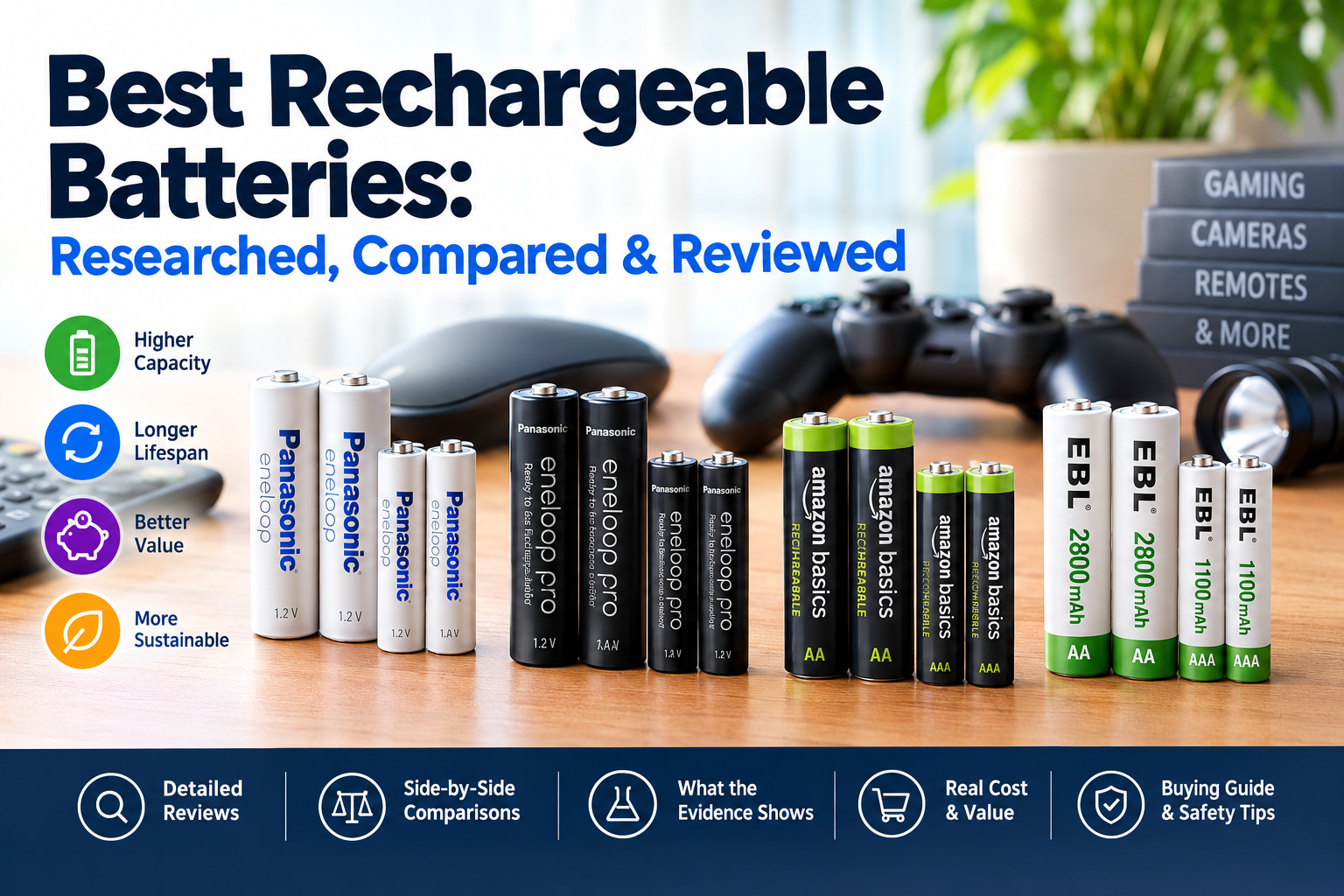
We compared four options readers ask about most: Panasonic Eneloop, Panasonic Eneloop Pro, Amazon Basics Rechargeable and EBL.
Quick verdict: Standard Panasonic Eneloop is the best all-rounder for most homes. Eneloop Pro is the pick when a high-drain device needs more runtime per charge. Amazon Basics is the budget choice, and EBL offers the biggest capacity numbers but the least proof behind them.
How to read our evidence labels
A spec or rating published by the brand or a retailer listing. Useful, but not independent.
Results from a publication or lab that tested the products itself and describes its method.
One person’s measurement or experience on a forum. Anecdotal; it never decides our verdict.
Our own reasoning about how the evidence fits together.
Best Rechargeable Batteries at a Glance
Panasonic Eneloop
Stays charged in a drawer and lasts through the most recharges. The safest default.
Panasonic Eneloop Pro
More runtime per charge for flashes, controllers and flashlights. Fewer lifetime charges.
Amazon Basics Rechargeable
Much lower price per cell than Eneloop in published UK pricing, with solid independent reviews.
EBL
The highest rated numbers, but the weakest independent evidence. Verify before you rely on it.
Rechargeable Batteries Compared
| Battery (AA) | Model identifiers | Rated capacity | Rated cycles | Charge retention | Price per cell (as reported) | Evidence type |
|---|---|---|---|---|---|---|
| Panasonic Eneloop | BK-3MCCA10FA (10-pack) | 1,900 mAh min | Up to 2,100 | Low self-discharge; Panasonic cites multi-year storage | Not verified | ManufacturerIndependent |
| Panasonic Eneloop Pro | BK-3HCCA4BA (US 4-pack), BK-3HCDE/4BE (EU 4-pack) | 2,500 mAh min (about 2,550 typical) | About 500 | Rated to keep about 85% after one year | About $5.85 ($23.40 per 4-pack, Expert Reviews 2024, converted) | ManufacturerIndependent |
| Amazon Basics (2,400 mAh) | “AA High-Capacity, 2,400 mAh” (no single model number; confirm on listing) | 2,400 mAh | Up to 400 (listing) | Not independently confirmed | About $2.33 ($9.31 per 4-pack, Expert Reviews 2024, converted) | ListingIndependent |
| Amazon Basics (2,000 mAh) | “AA 2,000 mAh Pre-charged” | 2,000 mAh | Up to 1,000 (listing) | Marketed as low self-discharge | Not verified | ListingIndependent |
| EBL | Varies by pack, e.g. “2,800 mAh AA 8-pack”; confirm on listing | Up to 2,800 mAh (rated) | Varies; not consistently documented | Reported weaker than Eneloop | Not verified | ListingEnthusiast |
Sources are listed at the bottom of this page. Prices are historical, converted from UK pounds at roughly $1.30 per £1, and are not current. We have not verified live prices, so we do not show them. Check the retailer listing for today’s price.
How We Evaluated Rechargeable Batteries
Our Selection Criteria
We shortlisted the four brands that appear most often in independent roundups and in reader questions, and we weighed each on six criteria:
Capacity
Rated vs independently measured mAh.
Cycle life
How many recharges the maker rates the cell for.
Retention
How much charge survives storage.
Consistency
Whether cells in a pack behave alike.
Compatibility
Sizes, voltage and charger needs.
Value
Cost per rated charge, not sticker price.
Capacity and Runtime Testing
For capacity we look for tests that discharge cells on a battery analyzer at a stated current down to a stated cut-off voltage. Capacity shrinks as the current rises, so a figure without a discharge rate is not comparable. For runtime we look for controlled loads such as a flashlight at a fixed current.
Charge Retention and Storage
We look for measurements taken right after charging and again after a defined storage period. Where only a manufacturer claim exists, we label it as one.
Charging Performance and Reliability
We check how a battery behaves with a smart charger, whether packs contain weak or dead cells, and whether reviewers saw consistent results across a pack.
Limitations of Our Evaluation
- No original bench testing yet. Nothing here is a TechNewGadgets measurement.
- Paywalled results. Which? lists Amazon Basics and Eneloop Pro cells among the 37 batteries it tested, but its detailed results are for members only, so we could not read them.
- Aging data. Some of the best lab data is years old and may not reflect current production, especially for Amazon Basics and EBL, whose suppliers can change.
- Forum reports are anecdotal. We show them, label them, and keep them out of our rankings.
Detailed Rechargeable Battery Reviews
1Panasonic Eneloop Review
Product: Panasonic Eneloop AA (and AAA), NiMH, 1.2 V, pre-charged; example model BK-3MCCA10FA.
| Rated capacity | AA 1,900 mAh minimum; AAA 750 mAh minimum Manufacturer |
|---|---|
| Rated cycles | Up to 2,100 Manufacturer |
| Retention | Low self-discharge; designed to be stored charged Manufacturer |
First-hand experience: We have not tested this battery ourselves.
Performance analysis: Independent roundups from Technobezz and others rank it first overall for its combination of recharge life and low self-discharge. In capacity terms, it is not the leader: Wirecutter’s 2016 lab testing found an Energizer cell with about 16% more capacity and 7% longer flashlight burn time at a similar price. Independent Editorial We read that as proof that capacity is only one strength. Eneloop’s advantage is dependable readiness after storage.
Advantages
- Highest rated cycle life here
- Ready to use after storage
- Consistent, well-documented specs
Limitations
- Lower capacity than Pro and some budget cells
- Higher cost per cell
Who should buy it: anyone with remotes, mice, clocks, toys or a spare-battery drawer. Who should skip it: users who need maximum runtime from a high-drain device. Consider instead: Eneloop Pro.
Price and value: We could not verify a current price. Its rated 2,100 cycles make the cost per charge very low once you use the cells repeatedly (see Real Cost).
2Panasonic Eneloop Pro Review
Product: Panasonic Eneloop Pro AA (and AAA), NiMH, 1.2 V; example models BK-3HCCA4BA, BK-3HCDE/4BE.
| Rated capacity | AA 2,500 mAh minimum (about 2,550 typical); AAA 900 mAh minimum Manufacturer |
|---|---|
| Rated cycles | About 500 Manufacturer |
| Retention | Rated to keep about 85% after one year Manufacturer |
First-hand experience: We have not tested this battery ourselves.
Performance analysis: Expert Reviews tested a four-pack of 2,550 mAh Pro AAs and found them nearly fully charged out of the box, and named the Pro its best AA overall in 2024. Independent The minimum capacity is about 30% above standard Eneloop (2,500 vs 1,900 mAh), which is the main reason to buy it. Manufacturer
Advantages
- Highest capacity from a major brand
- Good for high-drain devices
- Trusted retention rating
Limitations
- Only about 500 rated cycles
- Costs more than budget cells
Who should buy it: photographers, gamers and flashlight users who recharge often. Who should skip it: low-drain devices, where standard Eneloop lasts longer. Consider instead: standard Eneloop for longevity or Amazon Basics 2,400 mAh for a lower price.
Price and value: Expert Reviews listed four cells for about $23.40 in 2024 (converted), or $5.85 per cell and roughly $0.012 per rated cycle. Confirm today’s price before buying.
3Amazon Basics Rechargeable Review
Product: Amazon Basics AA NiMH in two lines: 2,000 mAh Pre-charged and 2,400 mAh High-Capacity. AAA lines are 800 mAh and 850 mAh. Check the pack for the exact model and generation.
| Rated capacity | AA 2,000 mAh or 2,400 mAh Listing |
|---|---|
| Rated cycles | Up to 1,000 (2,000 mAh) and up to 400 (2,400 mAh) Listing |
| Retention | Amazon markets very gradual self-discharge on the standard line Manufacturer |
First-hand experience: We have not tested this battery ourselves.
Performance analysis: Which? has tested both AA lines (most recently dated 2019 and 2022) but keeps its scores behind a paywall. Expert Reviews called Amazon Basics the best combination of value and performance, at about $9.31 for four (converted). Independent One enthusiast measured about 2,350 mAh from the 2,400 mAh cells at a 700 mA discharge, close to the rating, with little variation between cells. Enthusiast We treat that as a single data point only.
Advantages
- Large price advantage per cell
- Multipacks of 8, 12 and more
- Two lines for different needs
Limitations
- Suppliers and quality can vary by batch
- High-capacity line has a lower cycle rating
- Independent retention data is thin
Who should buy it: households replacing many disposables. Who should skip it: buyers who want documented retention in every cell. Consider instead: Eneloop for storage.
Price and value: About $2.33 per cell for the 2,400 mAh line in 2024, or roughly $0.006 per rated cycle. Check the live price.
4EBL Rechargeable Review
Product: EBL NiMH AA and AAA in several capacities (AA up to 2,800 mAh rated; AAA about 1,100 mAh). Model numbers vary by pack, so confirm on the listing.
| Rated capacity | AA up to 2,800 mAh Listing |
|---|---|
| Rated cycles | Varies by model; not consistently documented |
| Retention | Reported weaker than Eneloop-class cells Enthusiast |
First-hand experience: We have not tested this battery ourselves.
Performance analysis: We found no independent lab test of EBL cells. Enthusiasts report strong capacity on analyzers, including one claim of more than 30% above Eneloop, but also weaker charge retention and occasional weak cells in a pack. Enthusiast A 2,800 mAh rating is well above the 2,500–2,550 mAh of the best-known premium AA cell, so we would treat it as unproven until a lab confirms it. Editorial
Advantages
- High rated capacity
- Many pack sizes
- Low price per mAh
Limitations
- No independent lab evidence found
- Reported pack-to-pack variation
- Reported weaker retention
Who should buy it: shoppers who rotate cells often in a high-drain device and will measure them. Who should skip it: anyone storing spares or powering critical gear. Consider instead: Eneloop Pro.
Price and value: We could not verify a current price. Compare cost per rated cycle once you confirm the cycle rating for your exact pack.
What Our Tests and Independent Evidence Show
Because we have not run our own bench tests, this section shows what independent and enthusiast sources found, kept apart so you can weigh them.
Advertised vs. Measured Capacity
| Source | Finding | Label |
|---|---|---|
| Panasonic, via retailer coverage | Eneloop AA 1,900 mAh min; Pro AA 2,500 mAh min | Manufacturer |
| Wirecutter (2016) | An Energizer AA delivered about 16% more capacity than Eneloop in lab testing | Independent |
| Budget Light Forum user, Maha C9000 at 700 mA | Amazon Basics 2,400 mAh averaged about 2,350 mAh; standard Eneloop about 1,880 mAh | Enthusiast |
| Budget Light Forum user, analyzer | EBL cells reported to give over 30% more capacity than Eneloop | Enthusiast |
Editorial Capacity ratings from major brands tend to hold up, and the one lab result we found favors a different brand than the one most people buy. Treat claims far above 2,500–2,600 mAh for an AA NiMH cell with caution until a lab confirms them.
Runtime Under Different Loads
Editorial Runtime follows capacity, but not one-to-one: the 16% capacity gap Wirecutter measured became a 7% burn-time gap. Higher current drains capacity faster, so high-drain devices reward cells that deliver current well, which is why Eneloop Pro is the usual flash and controller pick.
Charge Retention After Storage
Low self-discharge is Eneloop’s defining feature, and Panasonic rates Eneloop Pro at about 85% after a year. Manufacturer We did not find a published independent storage test comparing all four brands, and the one review claim we saw about Amazon Basics 2,400 mAh retention was not backed by a method, so we leave it out. Which? says Amazon markets its AAA cells to hold most of their capacity over two years, but that is a company claim. Manufacturer Enthusiast testers say EBL cells lose charge faster than Eneloop. Enthusiast
Consistency Between Cells
Expert Reviews found Eneloop Pro cells nearly full from the box. Independent The forum user who tested Amazon Basics 2,400 mAh found a narrow spread between cells, and several EBL buyers report occasional weak cells. Enthusiast Pack consistency is where unbranded and budget cells carry the most uncertainty, so test a new pack before trusting it in anything important.
Real Cost of Rechargeable Batteries
Price per cell is a poor guide. The better measure is cost per rated charge = pack price ÷ cells ÷ rated cycles. Wirecutter found that good rechargeables cost less than 5¢ per charge over their life.
| Battery | Reported pack price | Cost per cell | Rated cycles | Cost per rated charge |
|---|---|---|---|---|
| Eneloop Pro AA | $23.40 for 4 (about) | $5.85 | ~500 | $0.012 |
| Amazon Basics 2,400 mAh AA | $9.31 for 4 (about) | $2.33 | up to 400 | $0.006 |
| Standard Eneloop, Amazon Basics 2,000 mAh, EBL | No verified price. Use the calculator below with the live price. | |||
These are dated prices, not current prices. Expert Reviews published them in pounds (£18 and £7.16 for four cells, 2024); we converted at roughly $1.30 per £1, so treat the dollar figures as approximate. Real-world cycle counts depend on how you charge and use the cells, and cells are often lost or damaged before they wear out.
Try it with today’s price
Editorial Long-term value favors the cell you will actually recharge hundreds of times. For rarely used devices, low self-discharge matters more than capacity. For heavy use, a higher-capacity cell cuts how often you recharge.
Best Rechargeable Batteries by Device
Wireless Mice, Keyboards and Remotes
These devices draw little current and often sit unused. Choose low self-discharge: standard Eneloop or Amazon Basics 2,000 mAh.
Gaming Controllers and Toys
Used often and drained quickly. Eneloop Pro or Amazon Basics 2,400 mAh give longer sessions. Keep a charged spare pair.
Cameras and Flashlights
Higher current makes capacity and cell quality matter more. Eneloop Pro is the usual pick; check the device manual for NiMH support.
Emergency Kits and Spare Batteries
Charge retention beats capacity here. Use standard Eneloop, store the cells in a case and top them up occasionally.
How to Choose the Right Rechargeable Batteries
AA vs. AAA
The physical size your device needs. AAA cells hold less charge (roughly 750–1,100 mAh) than AA cells (1,900–2,800 mAh rated), so AAA devices need charging more often.
Capacity vs. Charge Retention
High-capacity cells such as Eneloop Pro deliver more per charge. Low self-discharge cells such as standard Eneloop keep their charge in storage and last through more recharges. Choose by how you use the device.
NiMH vs. Alkaline
NiMH is rechargeable at 1.2 V nominal. Alkaline is single-use at 1.5 V. Most devices accept NiMH, but check the manual for devices with strict voltage needs.
Choosing a Compatible Charger
Use a charger made for NiMH in your cell size, ideally a smart charger that monitors each cell. See our best battery chargers guide.
How to Check Product Quality and Authenticity
- Buy from the brand’s own store or a reputable seller.
- Compare the printed model number and capacity with the manufacturer’s site.
- Be skeptical of capacity claims far above the best-known cells.
- Test a new pack: charge fully, check that every cell takes a charge and holds it for a day.
Rechargeable Battery Safety and Maintenance
- Charge and use cells in matched sets so they age evenly.
- Use a smart charger and avoid very cheap chargers that can overcharge.
- Store cells somewhere cool and dry, in a case so terminals cannot short.
- Top up spare cells every few months if you store them for a long time.
Frequently Asked Questions
What are the best everyday rechargeable batteries?
Standard Panasonic Eneloop is our pick for most homes because of its low self-discharge and long rated life. Choose Eneloop Pro if a high-drain device needs more runtime.
How long do rechargeable batteries last?
Runtime per charge depends on capacity and what you power. Overall life depends on recharge cycles, rated at up to 2,100 for standard Eneloop and about 500 for Eneloop Pro. Actual life depends on how you use and store them.
Do rechargeable batteries lose charge in storage?
Yes, all of them do. Low self-discharge cells such as Eneloop lose it slowly, while ordinary NiMH cells lose it faster. Charge spares and top them up now and then.
Can I use NiMH instead of alkaline batteries?
In most devices, yes. NiMH runs at 1.2 V rather than 1.5 V, so a few devices may show low battery early. Check the device manual.
Which charger should I use?
One designed for NiMH in your cell size. A smart charger that handles each cell separately is best.
Can I mix different battery brands?
Avoid it. Different capacities and charge levels drain unevenly and can shorten life. Use matched sets.
Final Verdict: Which Rechargeable Battery Should You Buy?
| Need | Our pick | Why | Evidence strength |
|---|---|---|---|
| Best overall | Panasonic Eneloop | Long rated life and low self-discharge | Strong (manufacturer and independent) |
| Higher capacity | Panasonic Eneloop Pro | Highest capacity from a major brand | Strong |
| Budget | Amazon Basics | Lowest reported price per cell with solid reviews | Moderate |
| High-capacity alternative | EBL | Highest rated mAh at a low price | Weak (no independent lab data found) |
Our advice: start with standard Eneloop for devices you use occasionally, add Eneloop Pro for the ones that drain fast, and buy Amazon Basics when you need many cells cheaply. Treat EBL as an experiment until independent testing catches up. Whatever you choose, confirm the exact model and today’s price before buying.
Related Guides and Editorial Disclosure
Sources
- Expert Reviews, Best rechargeable batteries (2024).
- Which?, Best AA and AAA rechargeable batteries (results for members).
- Wirecutter’s 2016 test, as quoted by The Loop.
- PC Games Hardware, Eneloop vs Eneloop Pro capacity ratings.
- Technobezz, Best rechargeable AA and AAA batteries.
- Enthusiast reports: Budget Light Forum and RadioReference (anecdotal).
Affiliate disclosure: TechNewGadgets may earn a commission when you buy through links on our site, at no extra cost to you. This does not affect our recommendations. Corrections: spotted an error or an outdated spec? Contact us and we will review and correct it.