


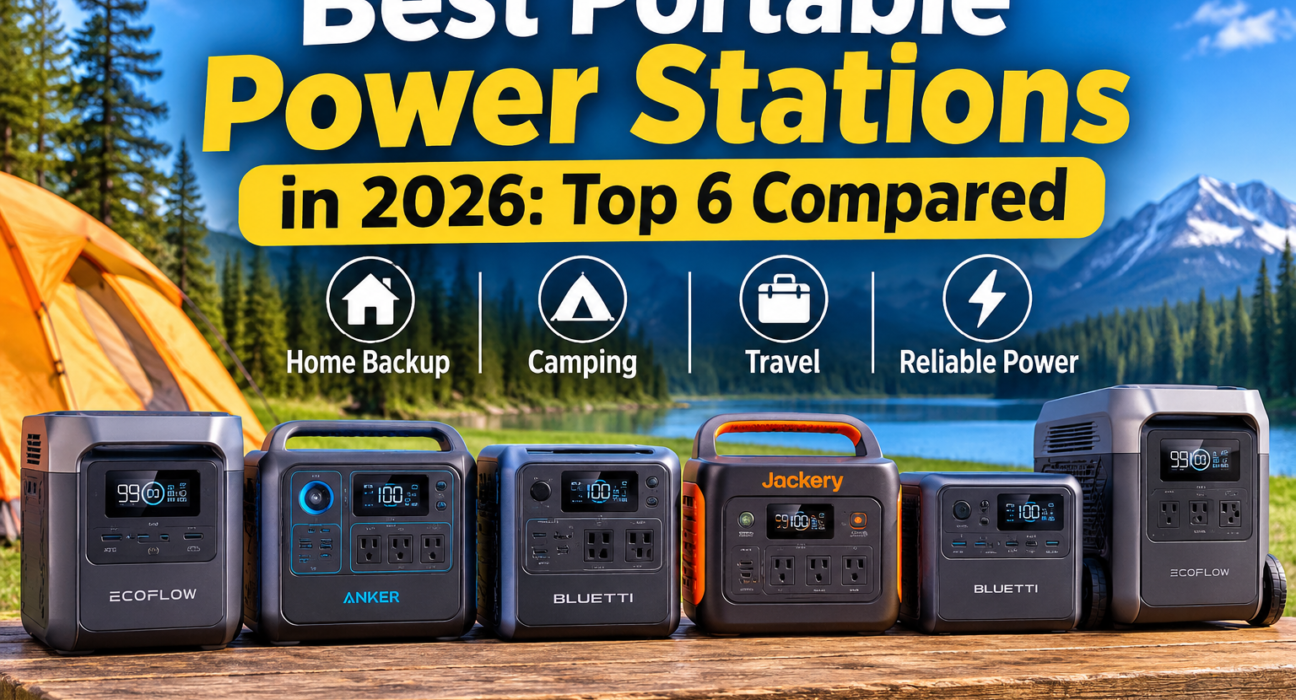
Best Portable Power Stations in 2026: Compared & Reviewed
A portable power station is a battery, an inverter, and a set of outlets in one box. The hard part is matching its watts and watt-hours to the devices you actually plan to run. This guide compares six popular models and shows you how to size one before you spend a dollar.
Best Portable Power Stations at a Glance
EcoFlow DELTA 3 Plus
Expandable, with a quick-switching UPS mode.
Anker SOLIX C1000 Gen 2
Advertised 49-minute full recharge in UltraFast mode.
BLUETTI Elite 200 V2
Twice the stored energy of a 1kWh unit.
| Model | Best For | Capacity | AC Output | Weight | Wh per Pound* |
|---|---|---|---|---|---|
| EcoFlow DELTA 3 Plus | Overall versatility | 1,024Wh | 1,800W | ~27.6 lb | 37 |
| Anker SOLIX C1000 Gen 2 | Fast charging, value | 1,024Wh | 2,000W | ~24.9 lb | 41 |
| BLUETTI Elite 200 V2 | Longer outages | 2,073.6Wh | 2,600W | ~53.4 lb | 39 |
| Jackery Explorer 1000 v2 | Camping, portability | 1,070Wh | 1,500W | ~22–24 lb | 45+ |
| BLUETTI Elite 30 V2 | Compact power | 288Wh | 600W | ~9.5 lb | 30 |
| EcoFlow DELTA Pro 3 | Larger home backup | 4,096Wh | 4,000W | ~113.5 lb | 36 |
*Our own calculation: advertised watt-hours divided by advertised weight (Jackery uses its 23.8 lb figure; sources vary). Higher means more stored energy per pound carried. Confirm the exact model and regional version before buying.
What Is a Portable Power Station?
Think of a very large power bank that also has wall-style outlets. It stores energy in a lithium battery and hands it out through AC outlets, USB ports, and DC connections. A phone power bank can’t run a TV or a fridge. A power station can, as long as the load stays inside its limits.
1. Battery
Stores the energy, rated in watt-hours (Wh).
2. Inverter
Turns battery DC into household AC. Its rating sets your maximum watts.
3. BMS
The battery management system guards against overcharge, deep discharge, and excess current.
4. Charge Controller
Manages incoming power from a wall outlet, solar panels, or a car socket.
How We Evaluated These Power Stations
The weights below show what we emphasized when comparing specs. They are not a formal scorecard.
| Factor | Weight | What We Looked At |
|---|---|---|
| Capacity & Output | 25% | Watt-hours, continuous watts, surge rating |
| Charging & Solar | 20% | AC speed, solar input limit, car charging |
| Battery Tech & Lifespan | 15% | Chemistry, cycle-life claims, warranty |
| Portability & Design | 15% | Weight, handles, display |
| Features | 15% | Ports, UPS, expansion, app |
| Value & Support | 10% | Price tier, warranty, service |
The 6 Best Portable Power Stations Reviewed
1. EcoFlow DELTA 3 Plus
This is the balanced pick. Its 1,024Wh battery and 1,800W inverter suit a home-office desk, a camping weekend, or a short outage. Its main edge is growth: add compatible batteries later, up to roughly 5kWh, instead of replacing the unit.
| Spec | Detail |
|---|---|
| Capacity / Output | 1,024Wh / 1,800W |
| Chemistry | LiFePO4 |
| Weight | ~27.6 lb |
| Solar Input | Up to 1,000W |
| UPS Switching | Advertised 10ms |
| Expansion | Up to ~5kWh with compatible batteries |
- Expandable storage
- High solar input for its class
- Fast UPS switchover
- Extra batteries add real cost
- 1kWh won’t carry a home for days
Best for: one unit that handles work, camping, and the occasional outage.
2. Anker SOLIX C1000 Gen 2
Anker pairs a 1,024Wh battery with a 2,000W inverter and about 3,000W surge. The headline is recharge speed: about 49 minutes to full at 1,600W, but only with UltraFast mode switched on in the Anker app and Anker’s own AC cable. If your grid power comes and goes, that speed is the feature to pay for.
| Spec | Detail |
|---|---|
| Capacity / Output | 1,024Wh / 2,000W (3,000W surge) |
| Chemistry | LiFePO4 |
| Weight | ~24.9 lb |
| Solar Input | Up to 600W |
| UPS Switching | ~10ms |
| Expansion | Not supported on Gen 2 |
- Strong output for the size
- Very quick wall charging
- Quiet under light loads
- No battery expansion
- Fast mode means more fan noise and heat
Best for: people who want maximum watts and fast turnaround from a roughly 1kWh unit.
3. BLUETTI Elite 200 V2
With 2,073.6Wh and 2,600W, this is the step up when a 1kWh unit runs dry too quickly. It can keep a fridge, router, and lights going longer, though real duration depends on what is plugged in.
| Spec | Detail |
|---|---|
| Capacity / Output | 2,073.6Wh / 2,600W |
| Chemistry | LiFePO4 |
| Weight | ~53.4 lb |
| Solar Input | Up to 1,000W |
| AC Input | Up to 1,800W |
| Expansion / Warranty | Not expandable / 5-year warranty |
- Roughly double the energy of 1kWh units
- Output covers several essentials at once
- Heavy for camping
- Costs noticeably more
- Not whole-home backup
Best for: households that expect multi-hour outages.
4. Jackery Explorer 1000 v2
It carries the most energy per pound of the six (about 45Wh/lb by our math), which is why it suits campers and photographers. The trade-off is 1,500W of output, the lowest among the 1kWh models here.
| Spec | Detail |
|---|---|
| Capacity / Output | 1,070Wh / 1,500W (3,000W surge) |
| Chemistry | LiFePO4 |
| Weight | ~22–24 lb (advertised weights vary) |
| Solar Input | Up to 400W |
| Expansion | No conventional external battery |
- Lightest per Wh of the group
- Simple to use
- Matching Jackery solar panels
- Lower AC output than rivals
- Lowest solar input of the 1kWh models
Best for: campers, road-trippers, and creators who carry their power.
5. BLUETTI Elite 30 V2
At 288Wh and 600W it covers phones, laptops, camp lights, and a router. It won’t run a fridge, and that is fine: it weighs about 9.5 lb and tucks into a backpack or a car door pocket.
| Spec | Detail |
|---|---|
| Capacity / Output | 288Wh / 600W (1,500W lifting power) |
| Chemistry | LiFePO4 |
| Weight | ~9.5 lb |
| Charging | AC and supported solar |
- Easy to carry
- Enough for laptops and phones
- Short runtime
- Not for high-wattage appliances
Best for: light travel, commuting, and small-electronics backup.
6. EcoFlow DELTA Pro 3
This is closer to a portable home battery than a camping gadget: 4,096Wh, 4,000W, 120V/240V output, and expandable storage. At about 113.5 lb you will wheel it, not carry it.
| Spec | Detail |
|---|---|
| Capacity / Output | 4,096Wh / 4,000W |
| Voltage | 120V / 240V support |
| Weight | ~113.5 lb |
| Solar Input | Up to 2,600W |
| Expansion | Compatible batteries |
- Highest capacity and output here
- 240V for larger loads
- Expandable
- Expensive
- Too heavy to move often
- Home hookup needs an electrician
Best for: homeowners backing up selected circuits.
Other Brands Worth Comparing
Goal Zero Yeti
Outdoor-focused; compare generation, solar support, and warranty.
DJI Power
A natural fit for drone pilots and creators already in the DJI ecosystem.
OUPES
Worth a look when you are weighing capacity, expansion, and price.
VTOMAN
Worth comparing on capacity, output, and price against the models above.
Portable Power Station Buying Guide
Battery Capacity: How Many Watt-Hours Do You Need?
Watt-hours measure stored energy. Usable energy is lower than the label because of inverter losses and battery protection limits.
| Capacity | Typical Use |
|---|---|
| 200–300Wh | Phones, tablets, lights |
| 300–600Wh | Laptops, cameras, routers, camp gear |
| 600–1,000Wh | Several electronics, small appliances, short backup |
| 1,000–2,000Wh | Longer backup, camping, selected appliances |
| 2,000–3,000Wh | Multiple essentials, longer outages |
| 3,000Wh+ | Higher-demand, expandable systems |
Continuous Output vs. Surge Output
Continuous watts are what the unit can supply steadily. Surge watts are a brief burst for motor startups. A fridge that runs at 150W may spike far higher when the compressor kicks in, so check both numbers and never buy on the surge rating alone.
LiFePO4 vs. NMC Batteries
| Feature | LiFePO4 | NMC |
|---|---|---|
| Cycle Life | Generally higher | Generally lower |
| Energy Density | Lower | Higher |
| Weight per Capacity | Often heavier | Often lighter |
| Thermal Stability | Generally better | Needs careful management |
Read the fine print on cycle claims: 4,000 cycles to 80% capacity is a stronger promise than 4,000 cycles to 70%.
Charging Speed, Solar, Ports, and UPS
- AC charging: check max input watts, whether fast mode is adjustable, and whether the cable is included.
- Solar: a 1,000W input rating does not mean 1,000W arrives. Shade, angle, heat, and voltage limits cut the real figure. Never exceed the unit’s input limits.
- USB-C PD: lets you charge laptops without waking the inverter, which saves energy.
- UPS/EPS: useful for routers and desktops, but it is not the same as a certified data-center UPS. Check the stated transfer time.
How Long Will It Run Your Appliances?
Use this formula: Runtime (hours) = Battery Wh × Usable Efficiency ÷ Appliance Watts. We assume a 1,024Wh unit with 85% usable AC energy, which gives 870.4Wh to spend.
| Appliance | Assumed Draw | Estimated Runtime |
|---|---|---|
| Wi-Fi Router | 10W | 87 hours |
| LED Light | 10W | 87 hours |
| CPAP Machine | 40W | 21.8 hours |
| Small Fan | 50W | 17.4 hours |
| Laptop | 60W | 14.5 hours |
| Television | 100W | 8.7 hours |
| Refrigerator | 150W average | 5.8 hours |
Illustrative math, not test results. Real runtime is lower with standby draw, compressor cycling, startup loads, cold weather, and a humidifier on a CPAP.
Which Power Station Fits Your Needs?
| Use Case | Suggested Capacity | Look For | Our Pick |
|---|---|---|---|
| Phone & Laptop Charging | 200–500Wh | USB-C PD, low weight | BLUETTI Elite 30 V2 |
| Weekend Camping | 500–1,000Wh | Solar input, light weight | Jackery Explorer 1000 v2 |
| Home-Office Backup | 500–1,000Wh | UPS mode, AC output | EcoFlow DELTA 3 Plus |
| Fridge Backup | 1,000–2,000Wh+ | Surge rating, capacity | BLUETTI Elite 200 V2 |
| RV & Van Life | 1,000–2,000Wh+ | 12V output, solar | Anker SOLIX C1000 Gen 2 |
| Selected Home Circuits | 3,000Wh+ | 120V/240V, safe integration | EcoFlow DELTA Pro 3 |
Drone pilots: capacity alone won’t tell you how many batteries you can recharge. Check your charger’s input watts and each battery’s Wh rating, then compare with the table above.
Power Station vs. Solar Generator vs. Gas Generator
| Feature | Power Station | Solar Generator | Gas Generator |
|---|---|---|---|
| Energy Source | Stored battery power | Battery plus solar panels | Gasoline or other fuel |
| Noise | Quiet | Quiet | Loud |
| Exhaust | None | None | Yes. Never run indoors |
| Long Runs | Limited by battery and recharge | Depends on sun | Depends on fuel supply |
| Upkeep | Low | Low | Engine maintenance |
“Solar generator” is usually a power station sold with panels, though some brands apply the label to a battery alone. Check what is in the box. Pick a battery unit for quiet, short-to-medium needs, a solar kit to refill without the grid, and a gas generator only if you have fuel, outdoor space, and a safe setup.
Features and Mistakes to Check Before You Buy
Cycle Life
Look at cycles and the end-of-life capacity percentage together.
Fan Noise
Fast charging and heavy loads spin fans up. Look for a quiet mode.
Weather Rating
Don’t assume weatherproof. Look for a published IP rating.
Warranty
Read the term, exclusions, and US service options, not the headline.
Travel Rules
Large lithium batteries face airline limits. Check carrier rules first.
Expansion Fit
Similar-looking models use different battery connectors.
Common Buying Mistakes
- Judging by watt-hours alone. A 2,000Wh battery behind a 600W inverter can’t run a 1,500W heater.
- Ignoring startup surge on fridges, pumps, and tools.
- Trusting advertised solar input as real-world output.
- Forgetting weight. A 113 lb unit is poor for camping.
- Buying an old model blind. Compare it against the current generation first.
- Skipping the warranty text.
What Owners and Independent Reviewers Report
Owner reviews tell you about living with a unit. Controlled tests give repeatable numbers. Use both, and watch for patterns rather than single complaints.
| Area | What to Look For in Reviews |
|---|---|
| Battery | Does real capacity match the claim? |
| Charging | Do speeds match the “advertised conditions”? |
| Fans | Noise at high load |
| App | Pairing, monitoring, firmware issues |
| Ports | Loose connectors, dropouts |
| Support | Warranty and replacement speed |
Outdoor, tech, and consumer-review outlets publish buying guides that cover capacity, charging, fan noise, and portability. They are good for spotting practical limits that a spec sheet hides.
How Much Should You Spend?
| Budget (USD) | What to Expect |
|---|---|
| Under $300 | Compact units for phones, laptops, lights |
| $300–$600 | Small-to-mid capacity, some camping models |
| $600–$1,000 | Capable 1kWh-class units |
| $1,000–$2,000 | Larger batteries, higher output |
| $2,000+ | High-capacity, expandable backup |
Planning ranges only. US sale prices swing widely around holidays, so check the maker’s US store and authorized retailers, and compare panel bundles to buying panels separately.
Care and Safety
Storage
Keep it dry and inside the maker’s temperature range. Don’t store a lithium battery fully empty for months.
Airflow
Keep vents clear while charging and discharging.
Accessories
Use approved cables and panels that respect voltage and current limits.
Firmware
Read release notes before updating through the app.
Never Backfeed: don’t plug a power station into a wall outlet with a male-to-male cable. Powering household circuits needs a proper transfer arrangement installed by a licensed electrician.
Frequently Asked Questions
What is the best portable power station in 2026?
No single model fits everyone. The EcoFlow DELTA 3 Plus is our versatility pick, the Anker SOLIX C1000 Gen 2 leads on charging speed and output, and the BLUETTI Elite 200 V2 offers more stored energy for longer outages.
How many watts do I need?
Add up the watts of everything you’ll run at the same time. Small electronics fit under 300–600W, while appliances often need 1,000–2,000W or more. Check startup wattage too.
Can a portable power station run a refrigerator?
Yes, if the inverter covers the fridge’s running and startup watts and the battery is big enough for your target runtime. A 150W-average fridge can use about 1,200Wh in eight hours.
Is LiFePO4 better than lithium-ion?
LiFePO4 is a lithium-ion chemistry. It typically offers longer cycle life and better thermal stability than NMC, while NMC packs more energy into less weight.
Can it run while it charges?
Many models support pass-through use, but limits vary. Check your manual before depending on it.
Can it power a whole house?
Large systems can feed selected circuits through proper electrical integration. A typical portable unit cannot run every appliance indefinitely.
Are they safe indoors?
They produce no engine exhaust, but you must follow the maker’s rules on ventilation, temperature, loading, and damaged batteries.
Can it run an air conditioner?
Only larger units with enough continuous output, startup capability, and capacity. Small units generally can’t.
How do I calculate the capacity I need?
Multiply each device’s watts by hours of use, add them up, and add 20–25% for losses. Then match the total to a unit with enough usable Wh and AC output.
Do power stations need maintenance?
Much less than gas generators. Store the battery properly, keep vents clear, and inspect cables now and then.
Final Recommendations: Which One Should You Choose?
| Need | Recommended Model | Main Reason |
|---|---|---|
| Overall Versatility | EcoFlow DELTA 3 Plus | Expansion and flexible charging |
| Fast Charging | Anker SOLIX C1000 Gen 2 | 2,000W output, ~49-minute recharge |
| Longer Backup | BLUETTI Elite 200 V2 | Larger battery |
| Camping | Jackery Explorer 1000 v2 | Best Wh-per-pound ratio |
| Compact Use | BLUETTI Elite 30 V2 | About 9.5 lb |
| Larger Home Backup | EcoFlow DELTA Pro 3 | 4,096Wh and 240V support |
Our Final Verdict
Start with your devices, not the product page. List what you want to run, total the watt-hours, and check the startup watts. For most buyers a balanced 1,000Wh-class model is the sensible first purchase. Move to a 2,000Wh-class or expandable system only if your outages or trips demand it.
These are specification-based editorial picks, not results from hands-on lab testing.